
· by Michael Blair, Nashville's Fence Company
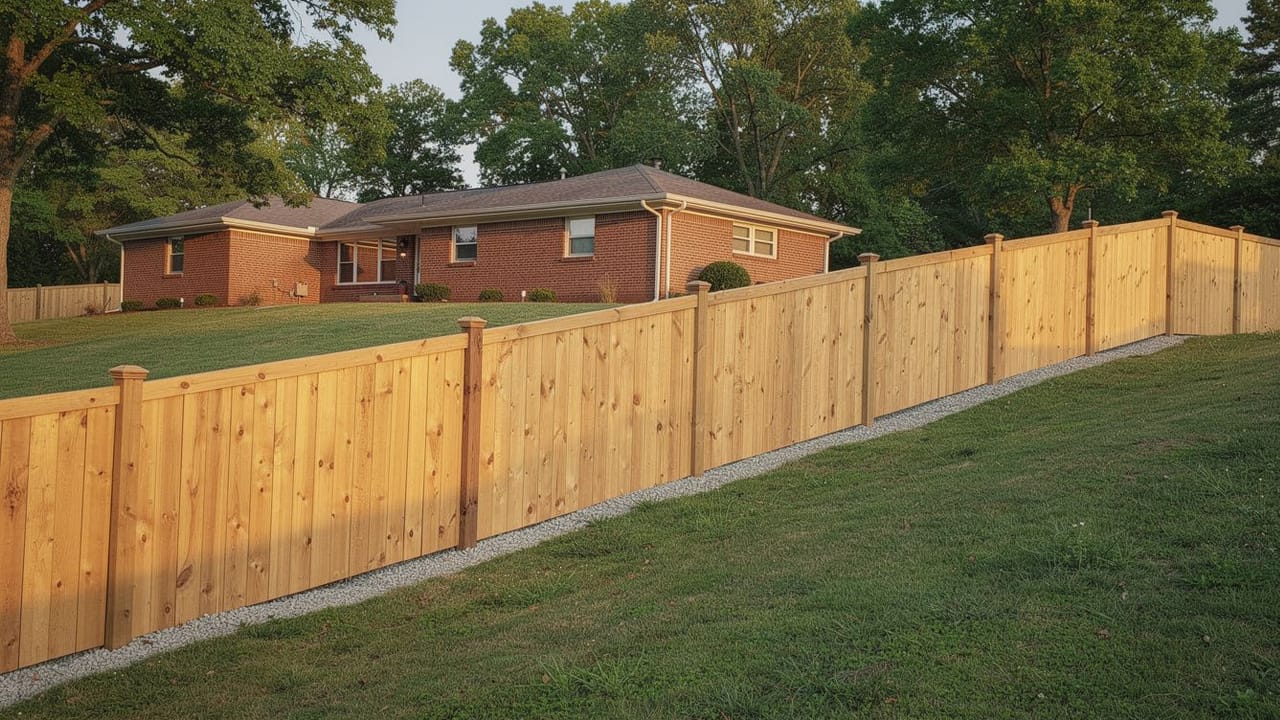
When a yard runs downhill, the fence has to follow the ground, and there are two ways to make it do that. A racked fence lets the rails angle with the grade so the pickets stay vertical and the bottom follows the ground closely. A stepped fence keeps each panel level and drops each one down like a stair. They look different, and they leave different gaps at the bottom, which matters most when there is a small dog to keep in; our post on fencing that actually contains a dog covers the rest of that problem.
What is a racked fence?
In a racked fence the horizontal rails run parallel to the slope and the pickets hang plumb from them, so the top of the fence follows the hill in one smooth line and the bottom keeps the same distance off the ground all the way down. When we build a wood fence on site, that is simply how it goes together: the rails follow the grade and each picket is cut to length at the top.
We rack gentle and moderate slopes. As the grade gets steeper the rails tilt harder, the pickets meet them at a sharper angle, and the fence starts to look strained, so at some point we would rather step it. We do not hold to one cutoff for that; we decide on the lot, with a level and a string line.
What is a stepped fence?
A stepped fence keeps each section level between posts and drops the next section to follow the grade, so the top reads as a run of short horizontal lines instead of one sloping one. It is how we install panels that are made to sit level, and it is our answer on ground too steep to rack cleanly.
The trade-off is the triangle of open space under the low end of every panel. On a steep run with long panels those triangles can open wide enough for a small dog to squeeze through, and they have to be closed with a kickboard, extra pickets cut to the ground, or a low course of block or stone. That closing work belongs in the price, so ask whether a stepped quote includes it.
Stepping also changes how tall the fence is where it counts. Metro Codes’ fence rules allow up to 8 feet beside or behind the house and measure that height from finished grade on whichever side of the fence has the greater exposure, so on a hill the downhill end of each stepped panel is the one to check. The setbacks for the front of the lot are in our post on fence permits in Nashville.
- Racked: smooth top line, even gap at the bottom, site-built wood or panels sold as rackable
- Stepped: level panels, stair-step top, a gap under each panel to close
- Closer posts mean a smaller drop, and a smaller gap, at each step
- Kickboards close the gaps and keep picket ends off the soil
What each material allows
Site-built wood racks naturally. Vinyl and aluminum usually arrive as made-up panels, and how far a given panel will follow a slope depends on how its maker built it, so we read the installation sheet for the exact style before we promise a racked line. Where a style is sold in a rackable version, we use that on a moderate grade; where it is not, the fence steps. Chain link is the easiest of them to run down a hill in our experience, because we stretch and tie the mesh on site rather than buying it built into a panel.
With any panel that has to sit level, a quote that calls the slope no problem means the fence will be stepped. Ask how the bottom gaps will be closed and get it on the drawing.
Posts, drainage and the bottom of the hill
Whichever method, we set posts plumb, never leaning with the slope, and on a hill we take the hole depth from the downhill side. For scale, one vinyl maker’s installation instructions call for holes 36 to 42 inches deep, depending on local ordinance or expected frost depth, and no shallower than 30 inches for its 5-inch posts.
The post at the bottom of a slope sits where the runoff ends up, and moisture is what lets wood rot. The Forest Products Laboratory’s Wood Handbook chapter on biodeterioration says serious decay happens only when wood is wetter than its fiber saturation point, which dried wood reaches from rain or from contact with wet ground. So that hole gets gravel in the bottom and concrete crowned to shed water away from the wood, the way we set posts for a wood privacy fence built to last.
Water also moves downhill along a fence line, and a solid privacy fence built across a slope can hold it back like a low dam. We leave a gap between the bottom boards and the ground, or lay a gravel strip, so runoff passes under rather than pooling against the uphill side. Metro Water Services describes runoff reaching the creeks through ditches, pipes and other drainage, and says stormwater must be properly managed to protect public and private property. If the fence also has to serve as a pool barrier, the gap at the bottom has a limit of its own, set out in our post on when a fence counts as a pool barrier. To have us walk the slope with you, ask for a free estimate.
Sources
- Metro Nashville Codes and Building Safety, Building Permits Central: I Want to Build a Fence — 8-foot maximum beside and behind the house; height measured from finished grade on the side with the greater exposure
- Illusions Vinyl Fence, Installation Instructions 0224 — Post holes 36 to 42 inches deep by local ordinance or frost depth; no less than 30 inches for 5-inch posts (one maker, own product)
- USDA Forest Products Laboratory, Wood Handbook (FPL-GTR-282), Chapter 14: Biodeterioration of Wood — Serious decay only above fiber saturation, reached from rain or contact with wet ground
- Metro Water Services, Stormwater Management — Runoff travels to streams through ditches, pipes and other drainage; stormwater must be properly managed to protect property
FAQ
Fencing on a Slope: Racked or Stepped — questions
Which is better on a slope, racked or stepped fencing?
For a gentle or moderate slope, racking, because it follows the ground closely and keeps an even gap at the bottom. For steep ground, or for panels made to sit level, stepping, with the gap under each panel closed by kickboards or cut pickets.
How do I stop my dog getting under a stepped fence?
Close the triangular gap under each panel with a kickboard along the bottom, pickets cut to follow the ground, or a low row of block or stone. Closer post spacing makes each gap smaller to begin with.
Can vinyl fence be installed on a hill?
Yes. How far a vinyl panel will follow a slope depends on the style and on its maker, so check the installation sheet for the product you are buying. Where a rackable version is sold, it can follow a moderate grade; otherwise the fence is stepped, with the gaps beneath each panel closed.
What is the best fence for a sloped yard?
One that can follow the ground. Site-built wood racks smoothly on gentle and moderate grades, and chain link runs down a hill most easily because the mesh is stretched and tied on site. Vinyl and aluminum panels follow a slope only as far as their maker built them to, so look for a rackable version or plan on stepping them.